
> ./blog / ai-in-indie-games-slop
Indie Games: Any AI, Automatic Slop?
This morning I replied to a post from Tim Sweeney about games being labelled for using AI. It got quite a bit of engagement, and a few people asked follow-up questions, so I wanted to write the longer version down properly.
Tim was quoting Jacob Navok, who had sketched out the economics of an indie developer choosing between traditional development and AI-assisted development, and argued that the AI label on Steam brings negative attention that makes those economics worse. Tim’s comment was simply: “This is exactly what’s happening.”
This was my reply:
The game
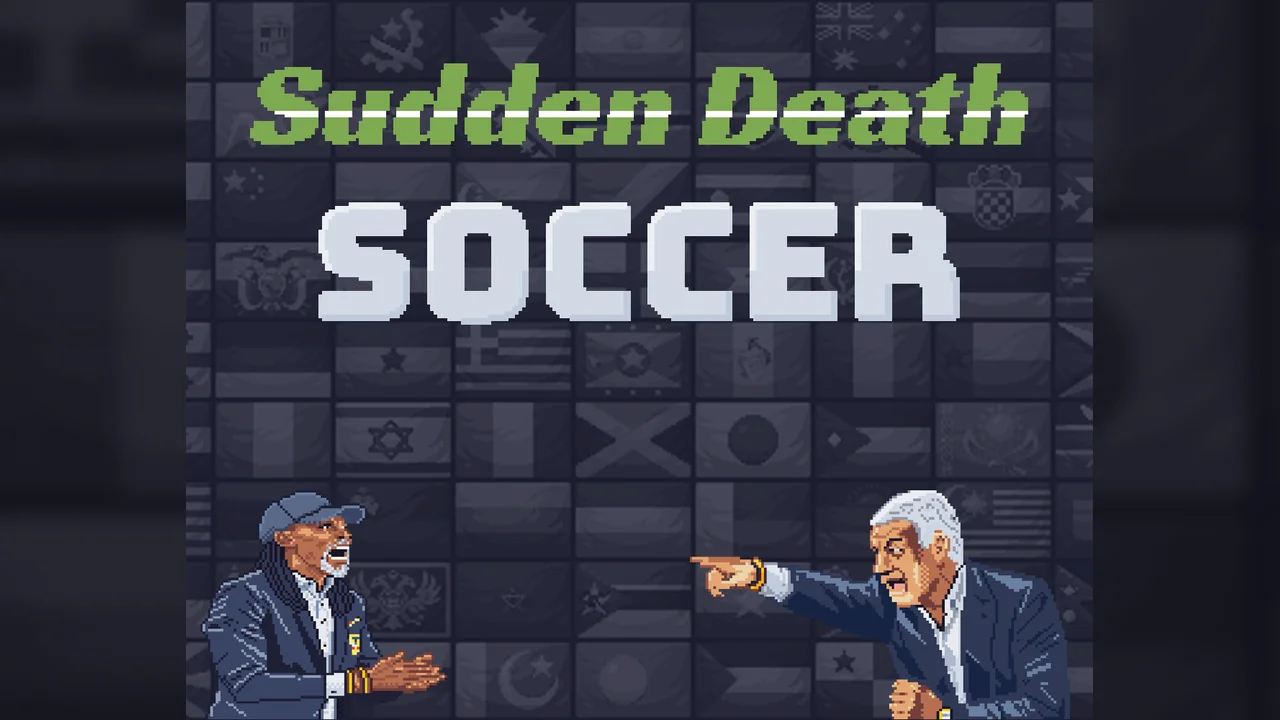
I’ve been working on a game called Sudden Death Soccer, a football management roguelite, for close to two years. For the first year, everything was done by hand, code included. Once agentic development got good enough, I started using it, and over the last year most of the code has been written by AI.
What I’ve deliberately kept by hand are the things players actually see. All of the art is hand-crafted. That was a conscious choice, even if my pixel art is of an (enthusiastic) amateur quality.
It combines the spirit of 90s management sims with modern roguelites: you pick a nation, earn card rewards after each match, and get sacked if your approval rating drops too far. It’s still in active development.
It’s worth saying what “written by AI” means for me, because I think “vibe coding” is a misused term. I’ve written code for 20 years. I prompt the AI to produce the exact code I had in mind, just in fewer keystrokes, and I check every line. If it’s not what I intended, I don’t accept it. To me it’s a natural evolution from using a good IDE with autocomplete.
This is a game I’ve poured literally hundreds of hours into, alongside a full-time job. It’s not something I’ve vibe coded in a weekend.
0% AI or 100% slop
The problem is that there’s now so much negativity towards any use of AI in games that it feels like if a game isn’t 0% AI, it’s considered 100% slop.
One person in the thread made a distinction I agree with: there’s a difference between someone who can code using AI under supervision, and using AI to generate art. But in the eyes of AI critics, there’s no differentiation. It’s either zero AI or slop.
Someone in the thread pointed out that Steam’s disclosure doesn’t extend to code. Steam’s Content Survey documentation focuses on AI used to create “content that ships with your game, and is consumed by players”, such as artwork, sound, narrative and localisation. itch.io’s generative AI disclosure does include code: it’s one of the options on the form, with its own “AI Generated Code” tag.
For me, it’s maybe not a huge issue, but I’d still hate to think something I’ve poured so much time into could be written off as slop.
I understand the resistance
I want to be clear that I’m not saying the people pushing back are wrong. I understand the resistance completely, and I respect the motivations behind it.
What I do think is that, in the long term, it’s a losing battle. As AI becomes ever more mainstream and ever more embedded in our software and our lives, I think generative AI will become hard to avoid, and reluctantly accepted.
What it’s done to my motivation
For me, the negativity has kind of destroyed my motivation to work on the game.
I’ve built game prototypes for years and never shipped one. I started this one before AI rendered my ability to write code largely obsolete. I had to adapt to using it in my day job, so I started using it on my side project too, in the hope that I would finally get a game to market.
As things currently stand, I don’t want to release a game that has any AI in it, only to have it declared slop.
Why it matters for indie developers
The thing is, for indie developers AI could be very empowering.
As I see it, many indie developers have suffered under predatory publishing deals, and have had to risk their personal finances just to launch their passion project. If they can produce it in less time, with less risk, and the product doesn’t suffer, that should be a net positive.
Shipping a game on your own, especially alongside a full-time job, is already a huge challenge. Writing every line of code by hand when there’s a tool that can do it faster, and that you can still check, feels woefully inefficient.
Unfortunately, indie developers can’t take advantage of that without risking being ostracised by the game community.
Where I hope we end up
My hope is that eventually we can reach a more balanced perspective on it, where the product itself is the important thing.
To the person playing Sudden Death Soccer, there’s no difference between a line of code I typed and a line I prompted, read and approved. The art they see is mine, and so are the hundreds of hours.
I’d like to think there’s room for a conversation about AI in games that’s more nuanced than 0% or 100%.
If you’re an indie developer weighing up the same question, or a player who feels strongly either way, I’d genuinely like to hear your view. Tell me what you think on X.