
> ./blog / shift-idea-to-working-product-ai-agents
From a 2am Idea to a Working Product in Two Days: Building Shift
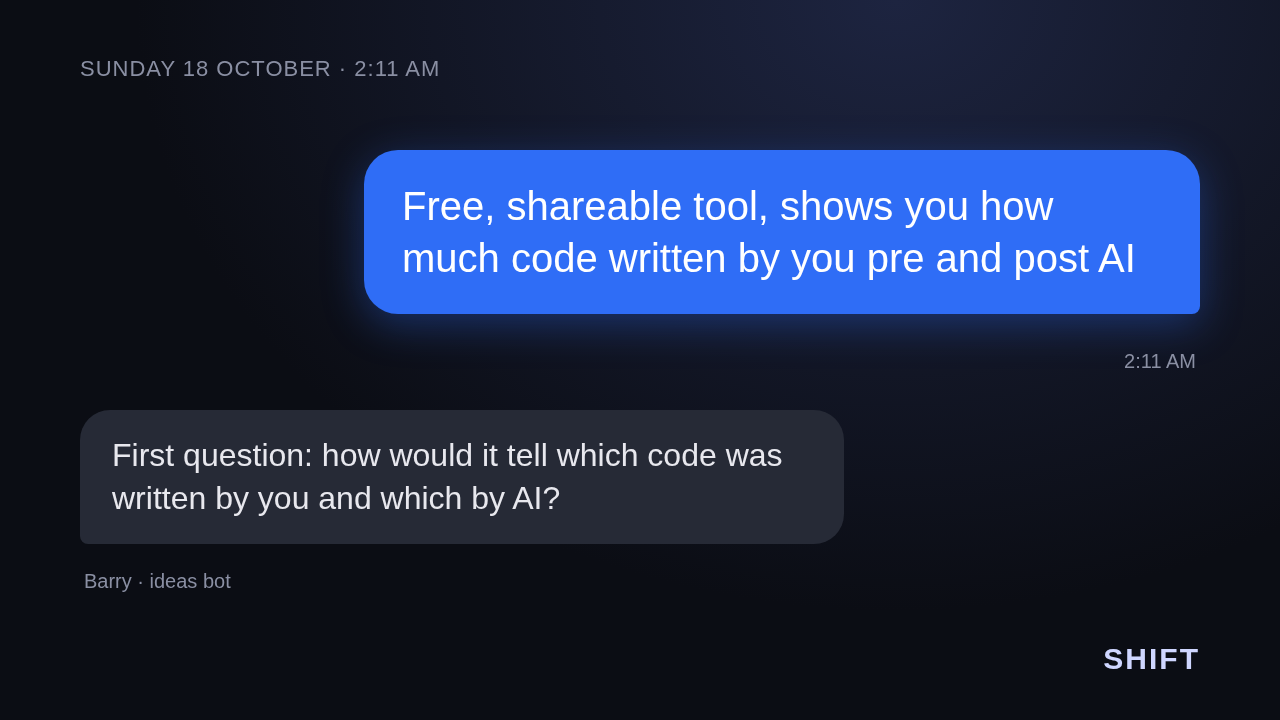
“Free, shareable tool, shows you how much code written by you pre and post AI”
That’s the whole message I sent to Barry (my ideas bot) at 2:11am on Sunday. Not exactly a spec. By Monday evening it had become two repositories, 86 commits and a working product called Shift.

That sounds like the kind of post I’d normally roll my eyes at. “I built a SaaS in a weekend with AI” is a whole genre now, but it is usually light on the detail. So this is the full story of how it came to be: what the agents did, where they needed me, and why I think the first few hours of a project matter more than ever.
What Shift is
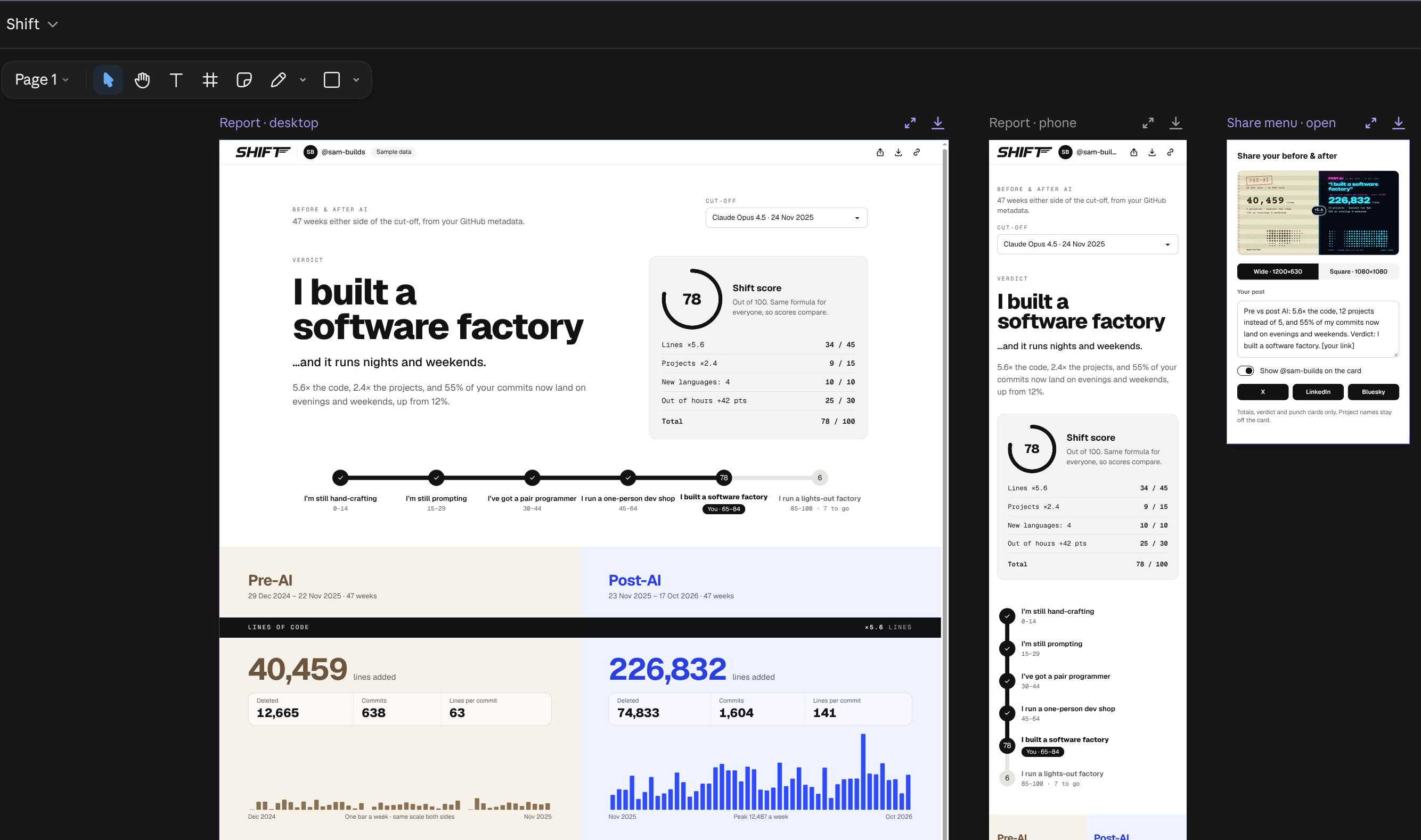
Shift compares your GitHub activity before and after AI coding went mainstream. You sign in with GitHub, pick a cut-off (by default the Claude Opus 4.5 release on 24 November 2025), and it builds a one-page report comparing the 26 weeks either side: commits, lines, languages, projects and active days. You get a Shift score out of 100 and a verdict on a ladder that runs from “I’m an artisan” to “I started the robot uprising”, plus share cards.
The hunch behind it is simple. Most of us are shipping far more code than we were a year ago. I suspect a lot of us are also working far more hours. Shift is a way to see whether that’s true for you.
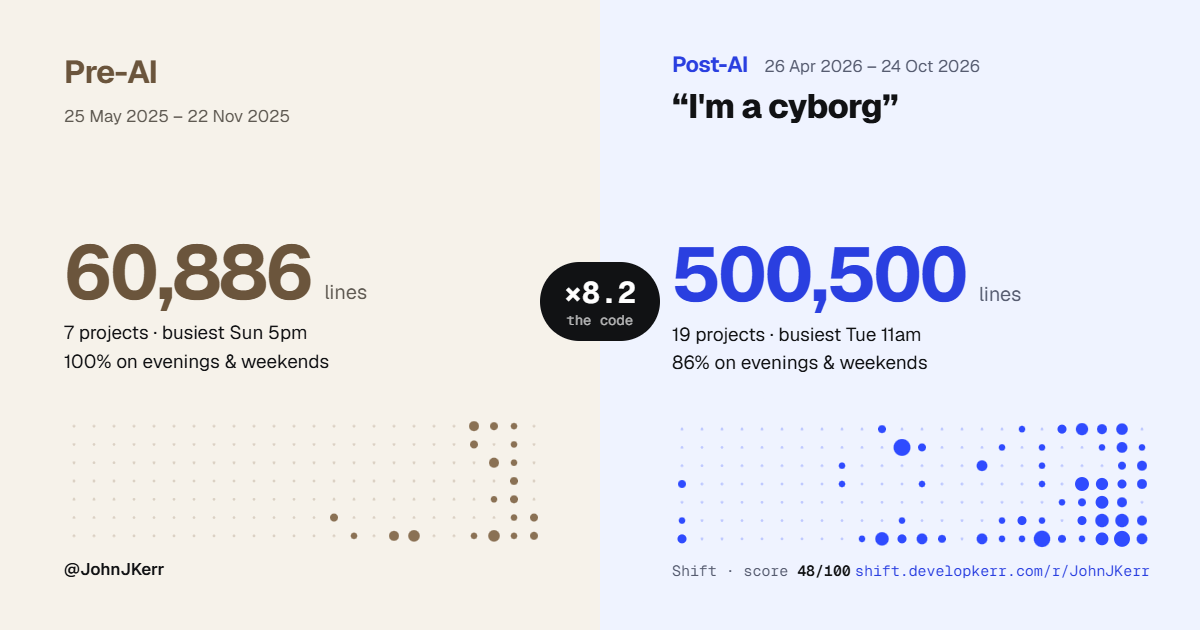
2:11am: the idea goes to Barry
Barry lives in Notion and his job is to catch ideas before they evaporate, check whether anyone’s already built them, and file them with my other side projects. That one line went in as “Pre vs Post AI Code Tracker”: a free, shareable tool showing how much code you wrote before and after AI coding went mainstream.
I’m not sure what sparked that idea at 2am! I presume it’s because I’ve been trying to be more active on X lately and regularly see a feed full of people talking about how AI has completely changed the way they work. I was yet to see anything really quantify it though, beyond our beloved GitHub green squares.
The useful thing about getting it written down at 2am is that I didn’t have to hold onto it. I went back to sleep.
The morning: fleshing it out
When I woke up, Barry and I turned a one-liner into something I could actually build. Most of that conversation wasn’t about features. It was about what Shift should be allowed to see.
GitHub sign-in can easily ask for far more access than a tool like this needs. Reading commit history or file contents means asking for permission to read people’s code, and nobody should hand that over for a fun report about their habits. So the rule from the start was metadata only: a GitHub App with a single permission, Metadata: read. That rules out a lot. The stats endpoints only give whole-repo numbers, some can’t filter by author, and very large repos return nothing useful. We accepted approximate numbers in exchange for not touching anyone’s code.
We also settled on a fixed default cut-off, so one person’s score can be compared with another’s.
Looking back on the exchange later that morning, I can see I was very vague about the initial idea, but that’s why I have a bot going back and forth with me on every idea. Obviously it’s mainly reflecting my own ideas, but I do find it a useful way to refine them.
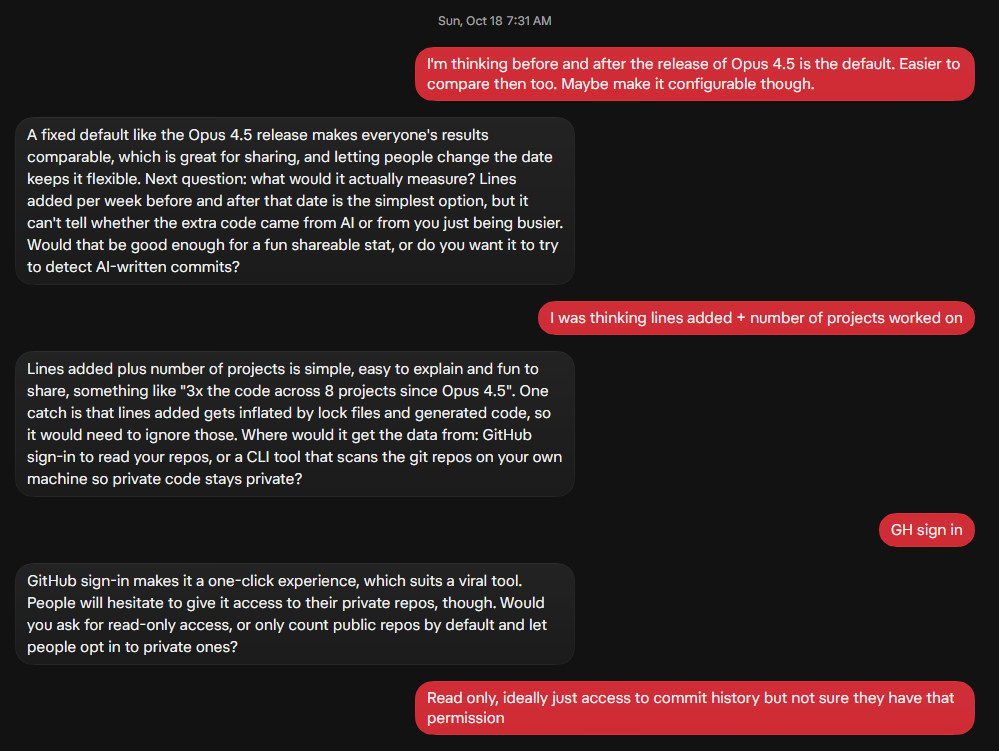
Design: Claude Design
Next the brief went to Claude Design. My initial idea was for one side of the screen to have an old-fashioned aesthetic and the other a futuristic one, but it looked terrible so that was quickly replaced with a cleaner design. I iterated a lot on the statuses and then, once I’d settled on the progression to robot clones, adding the artwork completed the look.
The first commit to the front-end repo landed at 13:41 on Sunday. It wasn’t just screens. It included a reference back end in TypeScript covering the windows, metrics and score, with tests, a mocked API, and Storybook stories for each state. I find all of the frontier models successful at implementing the output of Claude Design, so there wasn’t a lot of iteration needed there.
I’ve found building against a mock API a good way of refining exactly which endpoints are needed, and it has changed the way I approach new apps. Historically I’d build out some of the real API before even thinking about the UI. I think this is a better approach as it forces me to focus on the user-facing elements before pouring time into the part they don’t really care about.
Building it: a day or two with the agents
The .NET API’s first commit went in at 17:46 on Sunday. By 18:25 it had 33 commits: windows, scoring, the sample report, GitHub metadata fetching, retries while GitHub computes stats, and sign-in through the GitHub App. 33 commits in 39 minutes. That’s what agents look like when they’ve got something solid to work from. Every commit is a small, green slice, test first, the way the API’s instructions ask for it.
By the end of Sunday the API had 59 commits and the front end had moved off its mocks and onto the real API. Monday added another 18 to the API and 6 to the front end.
It would be easy to stop there and say the agents built it. They didn’t, not on their own. The commit history shows where the judgement came in:
- Tests. At 20:14 on Sunday all three test projects were rewritten. Agents tend to group assertions whereas I prefer each test to focus on one behaviour.
- No session at all. Sign-in first used a session cookie, which brought CORS, CSRF checks and token expiry handling with it. An hour later it was replaced with a background job: the GitHub token is used to build the report and is never stored. Simpler and safer. Low friction and minimal permissions were things I was constantly pushing for.
- Never keep repo names. The last commit on Sunday, at 22:03, drops repository names entirely, public or private. Real reports list projects without names.
- A reverted shortcut. On Monday evening the API switched to GraphQL, which looked faster and would have given commit times for an “active hours” measure. Within 16 minutes it was reverted. Reading commit history needs a permission that tells users the app can read their code, and without it GraphQL quietly drops private repos.
- Scoring that’s fair. As expected, lines of code is not a great measure of anything. One week of generated code or lockfiles can outweigh a year. The score was reworked to weigh commits over lines, and to measure change against your own past rather than how much you work.
- Windows with limits. An old cut-off, like the ChatGPT launch, meant comparing years of history, and one report failed after more than three minutes. Both windows are now capped at 26 weeks.
Those decisions are all written down in a decisions file in the repo, so the next agent session reads why things are the way they are before changing them.
As always, agents aren’t going to push back too hard. If I’d allowed them to request maximum permissions and persist tokens, they would gladly have done so, but it would’ve been completely wrong for the project and added a security burden I didn’t want.
Zero trust, then let them scale it
After a year of working with AI coding agents every day, this is the thing I’m most sure of: start a new project with zero trust in the agents.
That’s not because they’re bad. It’s because they copy. Agents are brilliant at doing more of whatever is already in front of them. Give them a codebase with clear structure, tests written one way, and a reason for every decision, and they’ll scale it faster than any team I’ve worked with. Give them a mess, and they’ll scale the mess just as quickly.
So the early hours are where I do the most work. I set the structure, the test style and the conventions, and I check everything. Once the patterns are there, I loosen the reins. I still tend to review most, if not all, of the output but I’m willing to leave it working through the changes and check the outputs rather than directing the whole process. I also have my repository of skills, which saves me repeating the same instructions for every new project.
A good initial codebase is everything. The speed only comes after that.
Then marketing, with Wayne
The last stop was Wayne, my marketing bot, who’s been helping plan how Shift gets in front of people. Shift is live at shift.developkerr.com. If nobody uses it, that’s fine. It was a fun couple of days and a good test of how I work now.
I’ve never iterated more on the way I work than I have in the last year. I feel curiosity and open-mindedness are the most important traits to have now as a developer, and projects like this are aimed at that as much as at getting users or monetising.
Try it yourself
Shift is live now – try it out and see how much your way of working has changed since the world was turned upside down.
Drop your score in the comments below. That comment box is another of my projects, and I’ve been doing a lot of work on it. More on that soon.