
> ./blog / my-shift-score-ai-github-activity
I Ran My Own GitHub Through Shift. It Called Me a Cyborg.
Everybody keeps talking about how AI has completely changed the way they work. Here’s your chance to prove it.
I built a tool that compares your GitHub before and after AI coding went mainstream. Then I ran it on myself. Here’s what it found, and why the number I care about isn’t the big one.
Shift is now live. You sign in with GitHub, it reads your commit metadata (never your code), and you pick the model that first got you pilled, from ChatGPT’s launch to GPT-5.5, or any date you like. It compares the 26 weeks before it with your most recent 26 weeks. I used the default, the Claude Opus 4.5 release on 24 November 2025.
You get a Shift score out of 100 and a verdict on a ladder that runs from “I’m an artisan” to “I started the robot uprising”. I’ve tried to balance it so it works for people that were prolific pre-AI and those that have only just started producing software.
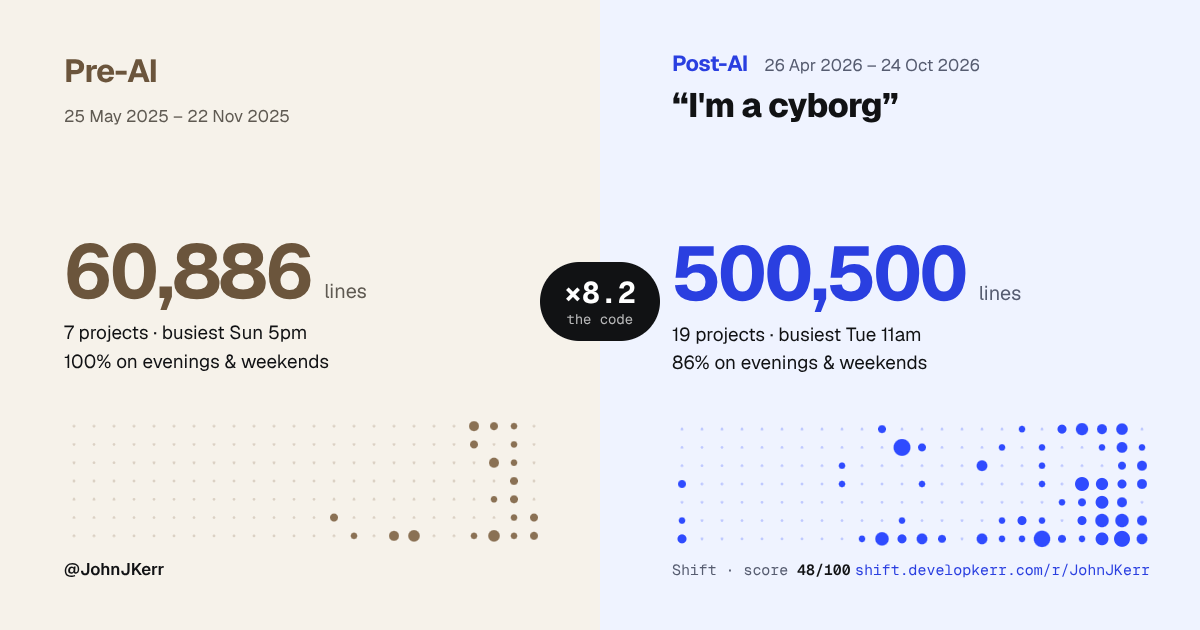
Mine is 48. “I’m a cyborg”.
It’s an interesting one for me, as I’ve done side projects on evenings and weekends for years, so my working patterns haven’t shifted that much, but I was surprised by just how much code I’ve generated.
The numbers
Comparing late May to November 2025 with late April to October 2026:
- Commits: 480 to 2,257. That’s 4.7 times as many.
- Lines added: 60,886 to 500,500. That’s 8.2 times as many.
- Lines per commit: 127 to 222.
- Projects: 7 to 19, 10 of them started in the last six months.
- Active days: 166 to 174, or 6.4 to 6.7 days a week.
- Languages: C# was 72% of what I wrote and is now 46%. JavaScript went from almost nothing to 26%.
The score breaks down into four parts. Output got 30 of 40. Projects got 11 of 15. Languages got 5 of 20. Time got 2 of 25. It may need some further balancing, so if you disagree with your score, let me know.
Looking at hours worked
When I had the idea for Shift, my hunch was that most of us are shipping far more code than a year ago, and a lot of us are also working far more hours. I wanted to see whether that was true for me.
It isn’t. Before the cut-off, every commit I made was in the evening or at the weekend. Now it’s 86%. I don’t have my day job pulling through, so this is all side projects, and maybe an indicator I’m moving towards having agents working around the clock.
Not much happens while I sleep yet or while I’m at work, so I’ve still got a way to go to catch up with some of the most prolific AI users.
More context switching
For me, the real change is the number of projects. I’ve gone from one project at a time to four or five. I’m not sure whether that’s a good thing or not.
In some ways it’s amazing to be progressing so many things at once as a solo developer. However, it’s extremely hard to stay locked into constant decision making across different contexts. I started a project recently in a complex domain and it’s difficult to stay in the loop on the decision making.
More code, but does that matter?
It’s easy to read an 8x jump in lines and feel like a machine. I don’t think it means much on its own.
Lines of code have always been a false metric, and I’ve always taken more pleasure from removing code than adding it. A single week of generated code or a lockfile can outweigh a year of careful work. That’s why Shift weights commits over lines, and measures you against your own past, not against anyone else.
In Should You Hire Developers in the AI Era? I said output is cheap and good decisions aren’t. My own report is a decent example. Nineteen projects in six months is a lot of output. The harder question is how many of them were worth starting.
I’m still maintaining them and even bringing old projects back from the dead, but I still have the nagging feeling I’d be better off focusing on one project at a time.
What Shift doesn’t tell you
Shift shows you the before and after. It doesn’t tell you whether the change is healthy. More commits could mean you’re more productive, or it could mean you’re working until midnight on things nobody needed.
That’s why time sits alongside output in the score. If your number is high because you’re shipping more in the same hours, great. If it’s high because AI ate your evenings, that’s worth knowing too.
Personally, I feel I’m working more than ever, and my existing workaholism has become a round-the-clock thing at the weekends. I’ve set up a server with T3 and agents so I can keep prompting on the go. I was even prompting agents on the Paris Metro a couple of weeks ago.
There’s something about the way these tools are priced that makes you feel you should have them working around the clock, from the 5-hour limits to the expiring resets. It’s not healthy, and it is something I’m trying to be more mindful of.
Get your own score
Pick the model that first got you pilled and compare the six months before it with the last six. Have you started using a new language? Has your output gone through the roof? Are your agents working 24/7?
Shift is free and needs read-only access to your GitHub metadata. It never reads your code and never stores your repository names.
It takes a few minutes for a big account. When it’s done, you get a report and a card to share. I’d genuinely like to know where you land on the ladder, and whether you’re working harder or just further.